
Table of Contents
Why can two custom fastener quotations for the same drawing be surprisingly different?
And why can a seemingly small drawing change sometimes have a much larger effect on price than changing the material itself?
The answer is that custom fastener cost is rarely determined by weight alone.
A manufacturer is pricing an entire production system: raw material, forming difficulty, tooling, machine time, secondary operations, inspection, tool wear, production volume, finishing, packaging and manufacturing risk.
This means the most useful question for a buyer is not simply:
“How much does this part cost?”
A better question is:
“Which requirements are creating the cost, and which of them are actually necessary for the part to function?”
For custom bolts, screws, shafts, sleeves, bushings and other non-standard cold-headed components, many cost decisions are effectively made before the purchase order is issued.
They are made on the drawing.
This guide breaks custom fastener pricing into nine major cost drivers and explains where purchasing and engineering teams can reduce unnecessary cost without reducing product performance.
Quick Answer: What Determines the Cost of a Custom Fastener?
The largest cost drivers are usually:
- Material and material condition
- Part geometry and forming difficulty
- Tolerances and critical dimensions
- Tooling complexity and expected tool life
- Secondary machining and additional operations
- Heat treatment and surface finishing
- Order volume and program life
- Inspection, testing and quality documentation
- Packaging, delivery and supply requirements
These factors do not operate independently.
A tighter tolerance may require secondary machining.
A harder material may shorten tooling life.
A larger flange may require another forming station.
A low annual volume may make a technically excellent cold-heading process economically unattractive.
That is why serious cost reduction begins with manufacturing-route optimization, not simply asking the supplier for a lower unit price.
Custom Fastener Cost Is More Than Material + Machine Time
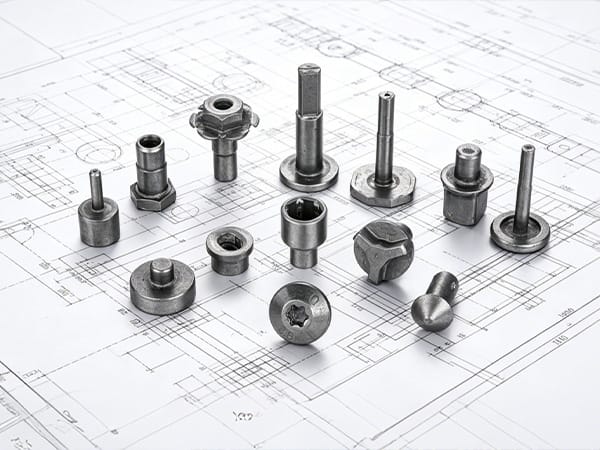
A useful way to think about custom fastener pricing is:
Total Part Cost = Material + Tooling Allocation + Forming + Secondary Operations + Finishing + Inspection + Packaging + Manufacturing Risk
The importance of each component varies dramatically between projects.
For a relatively simple high-volume cold-headed part, tooling may be significant at the beginning but become a small portion of the lifetime unit cost.
For a low-volume precision component with several machined features, machining and inspection may remain important cost drivers on every piece.
For a severe-forming geometry, tooling wear may matter more than raw-material weight.
For an automotive program, inspection, traceability and PPAP requirements can also become meaningful parts of the total project cost.
This is why comparing quotations only by price per piece can be misleading.
The Cost Question Buyers Should Ask First
Before negotiating price, ask:
What are the three most expensive requirements on this drawing?
A capable custom fastener manufacturer should be able to explain them.
The answer might be:
- A particularly tight concentricity requirement
- A deep internal recess
- A very large flange-to-shank ratio
- Stainless steel forming difficulty
- A secondary ground diameter
- A low-volume order
- A special coating
- 100% inspection
- A difficult packaging requirement
Once these drivers are visible, buyers and engineers can decide whether each one is genuinely necessary.
1. Material: The First Cost Driver, but Rarely the Only One
Material is the most obvious part of a quotation.
It is also one of the easiest areas to oversimplify.
A buyer may assume that changing from carbon steel to stainless steel only changes the raw-material price.
In reality, the material can affect the entire manufacturing process.
Material price matters
Different materials have different base costs and market conditions.
Custom fasteners may be produced from materials such as:
- Low-carbon steel
- Medium-carbon steel
- Alloy steel
- Stainless steel
- Copper
- Brass
- Aluminum
- Application-specific alloys
But price per kilogram is only part of the equation.
Formability also matters
Cold heading depends on controlled plastic deformation.
A material that is more difficult to form may require:
- More forming stages
- Lower forming severity per station
- Improved lubrication
- Different tool materials
- More frequent tool maintenance
- Intermediate processing
- Additional process development
In other words:
A more expensive material can also create a more expensive manufacturing route.
Material condition matters too
Two wires with the same nominal grade do not always behave identically during cold forming.
Important factors can include:
- Hardness
- Ductility
- Spheroidizing condition
- Surface preparation
- Wire diameter consistency
- Chemical composition
- Coating or lubrication condition
This is particularly important for components with severe deformation.
What buyers can control
Do not specify a material simply because it was used on a previous product.
Instead, define the functional requirement:
- Required tensile strength
- Yield strength
- Hardness
- Corrosion resistance
- Temperature exposure
- Conductivity
- Magnetic behavior
- Fatigue requirement
Then ask whether another material can achieve the same functional result with better manufacturability.
Cost question to ask your supplier
“Is this material required by the application, or is there a more formable grade with equivalent functional performance?”
2. Geometry: Small Features Can Create Large Cost Differences
The amount of metal in a part does not necessarily tell you how difficult the part is to manufacture.
A 20-gram component with challenging geometry can cost more to produce than a much heavier but simpler component.
For cold heading, cost is strongly influenced by how the material must move.
Geometry that can increase forming difficulty
Examples include:
- Large heads or flanges relative to the shank
- Multiple diameter transitions
- Deep recesses
- Thin walls
- Long unsupported sections
- Hollow structures
- Sharp corners
- Narrow shoulders
- Off-center features
- Internal extrusion
- Splines or polygonal forms
- Complex combinations of forward and backward extrusion
Each feature may be technically possible on its own.
The challenge is producing all required features within a reliable forming sequence.
More difficult geometry may require more stations
A simple part may be formed in relatively few steps.
A complex component may require progressive redistribution of material across several stations.
Additional stations can mean:
- More tooling
- More tool-development work
- Greater setup complexity
- More dimensions interacting with one another
- Higher investment before production
This does not mean complex cold-headed parts are automatically expensive.
At sufficient volume, forming several functions into one component may still be much more economical than machining them individually or assembling several separate parts.
Functional integration can reduce total assembly cost
A custom part may combine:
- Fastening
- Spacing
- Location
- Anti-rotation
- Torque transfer
- Guidance
- Stop position
- Pivot function
A slightly more expensive fastener may therefore eliminate:
- A washer
- A spacer
- A pin
- A sleeve
- A machining operation
- An assembly step
This is why buyers should evaluate assembly cost, not only fastener cost.
Romy discusses this issue further in Non Standard Fasteners vs Standard Hardware: When Customization Pays Off.
What buyers can control
Before freezing the drawing, ask:
- Does every feature need to be part of the fastener?
- Can two steps be converted into one smooth transition?
- Does this corner require a sharp radius?
- Can the geometry be adjusted to improve material flow?
- Can several assembly components be combined into one cold-headed part?
For more detailed DFM considerations, see 7 Design Rules for Reliable Cold Heading Parts.
3. Tolerances: Precision Is Valuable, but Unnecessary Precision Is Expensive
One of the most common hidden cost drivers in custom made fasteners is over-tolerancing.
A drawing may contain very tight tolerances because:
- They were copied from a machined component
- CAD software applied default values
- A previous supplier used them
- Engineering wanted to be conservative
- Functional and non-functional dimensions were not separated
The result can be a part that is more expensive to manufacture than the application requires.
Why tighter tolerances increase cost
A tighter tolerance may require:
- More precise tooling
- More frequent tool adjustment
- More frequent inspection
- Slower production
- Additional sorting
- Secondary machining
- Grinding
- More frequent tool replacement
- Higher scrap risk
The important point is that the cost increase is not always gradual.
A small tolerance change can push a dimension from:
“stable in the forming process”
to:
“requires machining after forming.”
That can fundamentally change the cost structure.
Not every dimension deserves the same tolerance
A useful drawing should distinguish between:
Functional dimensions
Dimensions directly affecting:
- Fit
- Sealing
- Thread engagement
- Torque transmission
- Bearing position
- Press fit
- Alignment
- Assembly
Process-sensitive dimensions
Dimensions affected strongly by tooling or later processing.
Non-critical dimensions
Dimensions with little impact on product function.
The manufacturer needs to know which is which.
A practical example
Imagine a stepped shaft with four diameters.
Only one diameter fits a bearing.
If all four diameters receive the same extremely tight tolerance, the supplier may be forced to machine or inspect surfaces that do not affect performance.
If the bearing diameter retains its critical tolerance while the others are relaxed appropriately, production may become much simpler.
The part still performs the same function.
The manufacturing cost changes.
What buyers can control
Label critical-to-function dimensions clearly and discuss them during DFM.
Ask:
“Which tolerance on this drawing is forcing an additional process?”
That question can uncover cost-saving opportunities very quickly.
4. Tooling: Do Not Look at Tooling Cost in Isolation
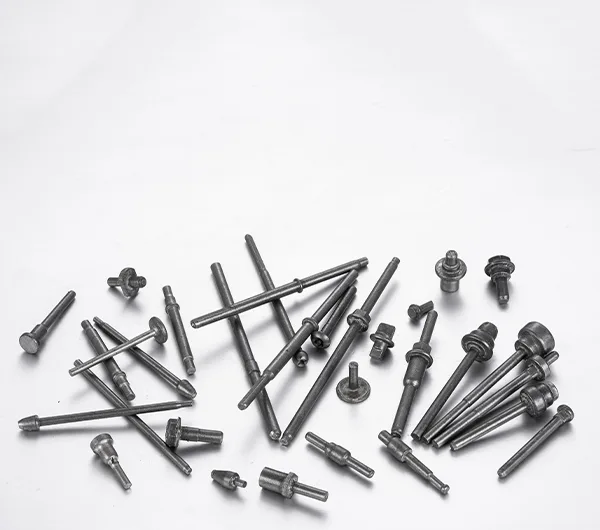
Custom cold heading normally requires dedicated punches, dies, inserts and related tooling.
This creates an obvious upfront cost.
For that reason, buyers sometimes compare cold heading and machining by asking only:
“Which process has the lower initial tooling cost?”
That can lead to the wrong conclusion.
Tooling is an investment across production volume
Assume a custom forming tool costs T and produces Q parts during the relevant production period.
The simplified tooling allocation per part is:
Tooling Cost per Part = T ÷ Q
As Q increases, the influence of initial tooling on each finished part decreases.
This is why custom cold heading becomes particularly attractive when geometry is stable and demand is repetitive.
Tool life also affects unit cost
Initial tooling cost is not the whole story.
The manufacturer must consider:
- Expected tool life
- Wear rate
- Replacement punches
- Die inserts
- Tool maintenance
- Regrinding
- Spare tooling
- Unplanned breakage risk
A cheaper tool that wears very quickly may create a higher lifetime manufacturing cost than a more robust tooling solution.
Geometry and material affect tool life
Tool wear can accelerate when the part includes:
- Severe extrusion
- Small radii
- High local forming pressure
- Difficult-to-form materials
- Deep recesses
- Thin punch sections
This means engineering choices made on the drawing can affect not only tooling development, but also every future production batch.
For more on this relationship, see Cold Heading Die Design: What Controls Tool Life and Part Accuracy?.
What buyers can control
When reviewing tooling costs, ask:
- Is the tooling intended for prototype validation or production?
- What does the tooling price include?
- Are replacement wear parts included?
- Who owns the tooling?
- What is the expected maintenance strategy?
- Is backup tooling recommended for the annual volume?
Do not negotiate tooling price separately from the expected program life.
5. Secondary Operations: Often the Biggest Hidden Cost
One of the most important questions in a custom fastener quotation is:
What happens after the part leaves the cold heading machine?
The answer can have a major effect on cost.
Typical secondary processes include:
- Thread rolling
- CNC turning
- Milling
- Drilling
- Grinding
- Slotting
- Deburring
- Heat treatment
- Cleaning
- Surface treatment
- Sorting
- Specialized inspection
Near-net-shape manufacturing creates the biggest opportunity
The more useful geometry that can be created directly during forming, the less material and machine time may be required later.
For example, cold heading may create the main:
- Head
- Flange
- Shaft
- Shoulder
- Sleeve
- Recess
- Pilot hole
- External form
CNC machining can then be reserved only for features that genuinely require cutting.
This hybrid approach can be more economical than either:
machining the entire part from bar
or
forcing every feature into the forming operation.
Romy covers this process decision in more detail in Cold Heading Manufacturing vs CNC Machining: Which Process Fits Your Part?.
Secondary operations repeat on every part
This is an important distinction.
Initial tooling may be paid once or amortized across the program.
A machining operation usually adds cost to every piece produced.
If an unnecessary machined feature adds only a small amount of cycle time, that time may appear insignificant during prototyping.
Across hundreds of thousands of components, it becomes much more important.
What buyers can control
Ask the supplier to identify every secondary process on the proposed routing.
For each one, ask:
- Why is it required?
- Can the feature be formed instead?
- Is the tolerance driving the operation?
- Could the geometry be changed?
- Is the operation functional or cosmetic?
This is one of the most effective ways to understand a custom fastener quotation.
6. Heat Treatment and Surface Finish: Specify Performance, Not Habit
Heat treatment and surface treatment can significantly influence custom fastener pricing.
The key is to specify what the component must achieve, rather than automatically applying the most expensive specification available.
Heat treatment affects more than hardness
Depending on the material and component, heat treatment may be required to achieve:
- Tensile strength
- Hardness
- Wear resistance
- Fatigue performance
- Toughness
But it can also introduce concerns such as:
- Distortion
- Scale
- Dimensional change
- Additional straightening
- Additional inspection
For precision shafts and long components, these effects may be especially important.
Surface treatment should match the environment
Possible finishes include:
- Zinc plating
- Zinc-nickel
- Phosphate
- Black oxide
- Passivation
- Electroless nickel
- Application-specific coatings
Each finish provides a different combination of:
- Corrosion resistance
- Appearance
- Friction behavior
- Coating thickness
- Cost
“More corrosion resistance” is not always the correct specification
The real questions are:
- Indoor or outdoor use?
- Salt exposure?
- Water exposure?
- Chemical exposure?
- Expected service life?
- Required salt-spray performance?
- Is appearance important?
- Does coating thickness affect thread or press fit?
- Is friction coefficient controlled?
Specifying a premium coating without a functional reason creates unnecessary cost.
Specifying too little protection creates failure risk.
What buyers can control
Describe the service environment and required performance.
Allow engineering and purchasing teams to compare viable finishing routes instead of specifying a coating solely because “we always use this finish.”
7. Production Volume: The Same Drawing Can Have a Different Best Process at 500 and 500,000 Pieces
Production volume is one of the most important variables in custom fastener cost.
It affects how tooling investment, machine setup and cycle time are distributed across the order.
Low-volume production
For small quantities, a process with minimal dedicated tooling may be attractive even if its piece price is higher.
This is why CNC machining often remains practical for:
- Prototypes
- Development parts
- Small batches
- Designs that are still changing
Repetitive medium- and high-volume production
When geometry is stable and demand increases, the economics can change.
A dedicated cold heading process may involve more engineering and tooling at the beginning but provide:
- Shorter repetitive cycle time
- High material utilization
- Consistent forming geometry
- Lower per-part processing effort
The correct break-even point is not universal.
It depends on:
- Part geometry
- Material
- Machine
- Tooling
- Secondary operations
- Inspection
- Annual demand
Annual volume is more useful than one purchase order
A supplier seeing an RFQ for 5,000 pieces may propose one manufacturing route.
If the actual program requires 300,000 pieces per year for five years, the best route may be completely different.
This is why buyers should provide:
- Initial quantity
- Annual demand
- Expected peak demand
- Program duration
- Possible future volume
What buyers can control
Share realistic lifecycle volume during the RFQ stage.
Do not hide forecast volume only to obtain a prototype price.
A manufacturer cannot optimize lifetime cost without understanding lifetime demand.
8. Inspection and Quality Requirements: Quality Has a Process Cost
Quality should never be reduced simply to lower price.
But quality requirements should be defined intelligently.
A custom fastener for a safety-critical automotive assembly does not necessarily need the same inspection plan as a non-critical adjustment component.
Inspection cost depends on the requirement
Possible approaches include:
- First-piece inspection
- Patrol inspection
- Batch sampling
- Functional gauges
- Optical inspection
- Automatic sorting
- 100% dimensional inspection
- CMM measurement
- Hardness testing
- Coating testing
- Material verification
The more complex or frequent the inspection, the more resources are required.
Documentation also matters
A project may require:
- Material certificates
- Dimensional reports
- Inspection records
- Control Plan
- PFMEA
- Capability studies
- PPAP
- Traceability
- Coating certificates
- Heat-treatment reports
These requirements should be defined before quotation.
100% inspection is not a substitute for process capability
This point is often overlooked.
If the manufacturing process is fundamentally unstable, checking every part may detect some defects, but it does not automatically solve the process problem.
The stronger approach is:
design a capable process + monitor critical characteristics + inspect appropriately for the risk.
What buyers can control
Separate:
critical product requirements
from
administrative requirements added by habit.
Ask:
- Which dimensions require recorded inspection?
- Which require functional gauges?
- Is 100% inspection truly necessary?
- What documentation does the end customer actually require?
- How long must traceability records be retained?
Define these requirements clearly before the supplier quotes the project.
9. Packaging, Lead Time and Supply Requirements Can Change the Final Cost
Packaging is often discussed near the end of a custom fastener project.
It should be discussed much earlier.
A fastener may be inexpensive to manufacture but relatively costly to protect, sort or deliver.
Packaging requirements can include
- Bulk packaging
- Small bags
- Fixed quantities per box
- Layered trays
- Individual separation
- Rust-prevention packaging
- Protective sleeves
- Export cartons
- Customer-specific labels
- Barcode labels
- Lot identification
- Returnable packaging
Precision parts with functional surfaces may require more protection than ordinary hardware.
Rush orders also affect manufacturing economics
Extremely short lead times can create:
- Overtime
- Schedule disruption
- Expedited material purchasing
- Expedited secondary processing
- Air freight
A predictable forecast usually provides more opportunities for efficient production planning.
What buyers can control
Discuss packaging and logistics during the RFQ, not after production.
Provide:
- Required pack quantity
- Label specification
- Corrosion protection
- Surface protection
- Shipment frequency
- Forecast
- Delivery destination
This allows quotations from different suppliers to be compared on the same basis.
Which Cost Factors Usually Matter Most?
There is no universal ranking, but this matrix helps explain how different requirements influence the quotation.
| Cost Driver | Upfront Cost Impact | Unit Cost Impact | Buyer Influence |
|---|---|---|---|
| Material choice | Medium | High | High |
| Complex geometry | High | Medium–High | High during design |
| Tight tolerances | Medium | High | High |
| Tooling complexity | High | Medium | Medium–High |
| Secondary machining | Medium | Very High | High |
| Heat treatment/coating | Low–Medium | Medium–High | High |
| Production volume | High economic impact | Very High | High |
| Inspection/documentation | Low–Medium | Medium | High |
| Packaging/logistics | Low | Low–Medium | High |
The most valuable cost reduction often happens when several factors are improved at the same time.
For example:
Simpler geometry → fewer tooling stages → better tool life → less secondary machining → faster inspection
A small design improvement can therefore affect several cost categories.
7 Questions to Ask When a Custom Fastener Quote Looks Too High
Before asking the supplier to “reduce the price,” ask these questions.
1. Which feature contributes the most manufacturing cost?
This identifies whether the main issue is material, tooling, machining, inspection or finishing.
2. Which tolerance is the most difficult to maintain?
A single critical tolerance may be creating an additional operation.
3. Which features require secondary machining?
Each secondary operation should have a technical reason.
4. Could a geometry change reduce the number of forming stages?
Small DFM adjustments can sometimes simplify tooling significantly.
5. Would another material provide equivalent performance?
Material substitution should be engineering-led, but it may improve both material cost and formability.
6. How does price change at different annual volumes?
Ask for realistic quantity levels rather than negotiating only one MOQ.
7. Which specifications are adding cost without improving function?
This question is particularly useful when reviewing legacy drawings.
Why Two Custom Fastener Manufacturers May Quote the Same Drawing Differently
A price difference does not automatically mean one supplier has a higher margin.
The two manufacturers may have interpreted the production route differently.
For example:
Supplier A
Cold heads the basic blank and machines three features afterward.
Supplier B
Develops a more complex progressive cold-heading tool and forms two of those features directly.
Supplier B may have:
- Higher tooling cost
- Lower recurring machining cost
Supplier A may have:
- Lower initial tooling cost
- Higher unit cost
Which quotation is better depends on production volume and program life.
Another supplier may select:
- A different machine
- Different tooling concept
- Different raw-material condition
- Different inspection frequency
- Different coating source
- Different tool-life assumption
This is why serious quote comparison requires more than looking at the final number.
A Better Way to Compare Custom Fastener Quotations
When evaluating suppliers, use a comparison table such as this:
| Requirement | Supplier A | Supplier B | Supplier C |
| Material/specification | |||
| Forming process | |||
| Number of secondary operations | |||
| Heat treatment | |||
| Surface finish | |||
| Critical inspections | |||
| Tooling cost | |||
| Tool ownership | |||
| Tool maintenance | |||
| MOQ | |||
| Unit price | |||
| Annual volume assumption | |||
| Sample lead time | |||
| Production lead time | |||
| Quality documents | |||
| Packaging |
This makes hidden assumptions visible.
Only after the scope is aligned does price become directly comparable.
Cost Reduction Should Start Before Tooling
The highest-value cost reduction usually happens before:
- Tooling is manufactured
- Samples are approved
- PPAP is completed
- Production is launched
Once tooling has been built around a specific geometry, changing the design becomes more expensive.
A practical development sequence is:
Drawing → Functional Review → DFM → Process Route → Cost Review → Tooling → Sampling → Validation → Mass Production
Not:
Drawing → Price Negotiation → Tooling → Discover Manufacturing Problems
For projects still in the RFQ stage, Romy’s guide on How to Brief a Custom Cold Headed Parts Manufacturer Before RFQ provides additional information on drawings, materials, tolerances, quantities and quality requirements to prepare before quotation.
When Paying More Per Fastener Can Actually Reduce Total Cost
The lowest fastener price is not always the lowest assembly cost.
Consider a custom component that replaces:
- One standard bolt
- One spacer
- One washer
- One anti-rotation feature
The custom component may cost more than the standard bolt.
But the assembly may require:
- Fewer purchased parts
- Fewer inventory items
- Fewer assembly motions
- Less risk of missing components
- Less line-side handling
- Simpler automation
- Fewer quality checkpoints
This is particularly important for high-volume OEM production.
The right cost metric may therefore be:
cost per completed assembly
rather than:
cost per fastener.
A Practical Cost-Reduction Checklist Before Sending Your RFQ
Before sending a drawing to a custom fastener manufacturer, review the following.
Function
- Is every feature functionally necessary?
- Are critical dimensions clearly identified?
- Is the operating environment defined?
- Are mechanical requirements clear?
Geometry
- Can sharp transitions be replaced with practical radii?
- Can unnecessary complexity be removed?
- Can several assembly components be integrated?
- Is the part suitable for near-net-shape forming?
Tolerances
- Are tolerances based on actual assembly requirements?
- Are non-critical dimensions unnecessarily tight?
- Which features may require machining because of tolerance?
Material
- Is the specified grade essential?
- Could a more formable grade meet the same requirement?
- Are hardness and strength requirements clearly defined?
Production
- Is annual demand included?
- Is expected program life included?
- Could volume increase later?
Quality
- Which dimensions are critical?
- Is PPAP required?
- Is 100% inspection required?
- What traceability is required?
Finishing
- What corrosion resistance is actually required?
- Is the coating defined by performance or habit?
- Does coating thickness affect fit?
Logistics
- Is special packaging required?
- Are fixed pack quantities required?
- Is the delivery forecast available?
This information gives the manufacturer more room to optimize the manufacturing route instead of simply pricing a fixed drawing.
Frequently Asked Questions
Why are custom fasteners more expensive than standard fasteners?
Custom fasteners usually require dedicated engineering, tooling, setup, validation and inspection that standard mass-produced fasteners do not. However, at sufficient volume, a custom cold-headed component can achieve a competitive unit cost and may reduce total assembly cost by combining several functions into one part.
How much does a custom fastener cost?
There is no useful universal price because cost depends on material, geometry, tolerances, tooling, order volume, secondary operations, heat treatment, surface finish, inspection and packaging. A drawing and expected annual volume are normally required for an accurate quotation.
What is the biggest factor affecting custom fastener cost?
It varies by project. For one component it may be material, while another may be dominated by secondary machining, tooling complexity or tight tolerances. One of the best questions to ask during DFM is which three requirements contribute most to the quoted cost.
Does a tighter tolerance always make a custom fastener more expensive?
Not always, but tight tolerances can increase cost when they require more precise tooling, frequent adjustment, additional inspection, secondary machining or grinding. Functional dimensions should receive the precision they need, while non-critical dimensions should avoid unnecessary restrictions.
Is cold heading cheaper than CNC machining?
Neither process is automatically cheaper. CNC machining can be economical for prototypes and low-volume complex parts because it may require less dedicated forming tooling. Cold heading can become more economical for repetitive medium- and high-volume production when the geometry is suitable. Some components achieve the best cost using cold heading for the main geometry and CNC machining only for critical features.
Does higher order volume reduce custom fastener prices?
It often can because tooling, setup and engineering costs are distributed across more parts, while efficient production equipment can run longer batches. However, the exact relationship depends on tooling life, material, cycle time, finishing and inspection requirements.
Can changing the design reduce custom fastener cost?
Yes. DFM changes to tolerances, radii, diameter transitions, recesses, material or secondary-machined features can sometimes simplify tooling and reduce production cost without affecting function. Design changes should always be reviewed jointly by product engineering and the manufacturer.
Why do different custom fastener manufacturers quote different prices for the same drawing?
Manufacturers may select different forming sequences, machines, tooling strategies, secondary operations, material sources, inspection plans and tool-life assumptions. Before comparing prices, confirm that each quotation includes the same technical and quality scope.
Should I ask for tooling and unit price separately?
Yes. Separating tooling investment from recurring unit cost makes it easier to evaluate total program economics. Also clarify tooling ownership, replacement-tool policy, expected maintenance and whether future design revisions require new tooling.
Reduce Cost by Engineering the Process, Not by Compromising the Part
The most effective custom fastener cost reduction does not come from blindly removing quality requirements.
It comes from understanding where cost is created.
For a well-engineered component:
- Material matches the actual application
- Geometry supports efficient manufacturing
- Precision is concentrated on functional dimensions
- Tooling is designed for the expected program life
- Secondary machining is used only where necessary
- Finishing matches the operating environment
- Production volume supports the selected process
- Inspection matches product risk
- Packaging protects the part without unnecessary complexity
That is the difference between price cutting and manufacturing cost optimization.
If you are developing a custom bolt, screw, shaft, sleeve, bushing, spline or other non-standard precision component, Romy can review your drawing, material, tolerances and projected volume before tooling to identify a practical manufacturing route.
Explore Romy’s Custom Cold Heading Solutions or send your drawing to the Romy team for a project review.